Suspect Photography

words and images from david george brommer

Adventures in Dripping Wet Photography, Wet Plate Collodion That Is.

Portrait of the Photographer Brenton Hamilton, 8×10 Tintype, 14″ Kodak Commercial Ektar 8 Seconds @ F 8

Late last June, I took a class on Wet Plate Collodion at the Maine Media Workshops with Jell Enfield. I had been wanting to take this class for a few years, but the schedules never seemed to coincide. However in 2012 the stars were in alignment and there I found myself in one of my favorite places in the world, the Hass Lab on the Maine Workshops homestead campus. Things were about to get wet and some interesting images were to be taken.

2012 Collodion Class at MMW shot at Rockport Harbor.
Fuji Xpro 1, 18mm Lens post process NIK Silver EFx Antique Plate II Filter.

Possibly one of the best aspects of this class were the other students and teacher assistants. Seems that Wet Plate attracts an odd lot of photographers so our group was always on the large size, which was great because a model (interesting, beautiful & cool at that) was easy to get in front of the camera. Also, the large number of T/A’s made it easy to get chemistry poured, cars loaded, darkroom tents set up, and advice. We had the assistance of a local who is a supplier for wet plate paraphernalia, Niles Lund. He would prove invaluable (he did a mod on one of my Fidelity 8×10 holders to a wet plate holder for $40) as a second to our fearless and silver stained instructor, the inimical Jill Enfield. Jill mixes passion, intuitiveness, and experience into her wet plate endeavors. It was an honor to spend the week with Jill and learn this technique. Check out Jill’s time lapse video of her shooting in NYC’s Tompkins Sq. Park to get a feel for Jill and the process.
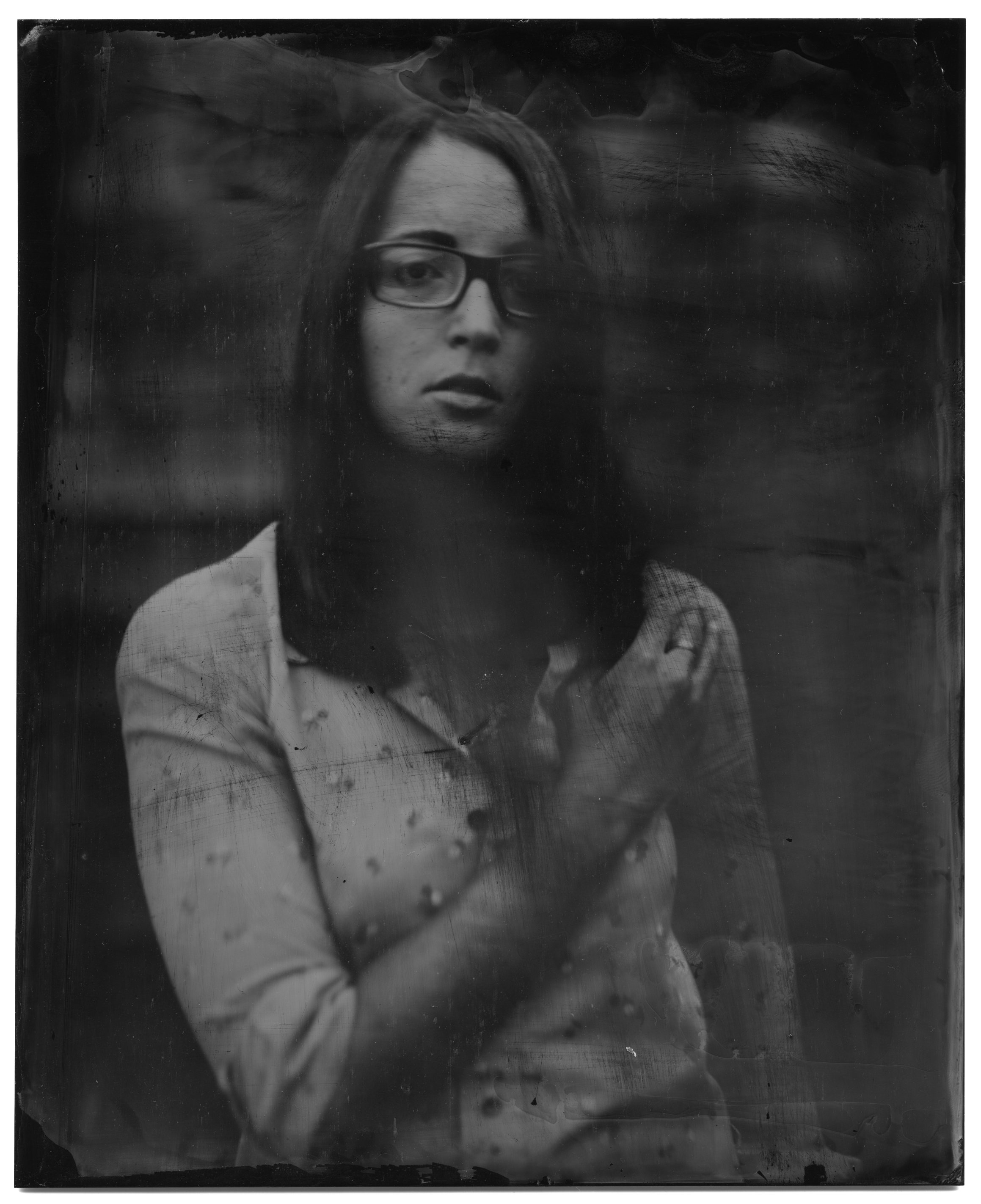
Portrait of Kendra 8×10 Tintype Kodak 14″ Comercial Ektar Lens, 10 Seconds F8 Note: Kendra is covered in beautiful tattoos, however since Collodion is sensitive to UV light, tattoos don’t show up in the image.

I’m not going to get into the technical details of wet plate. My fellow student, uber geek and all around super cool photographer chick Sarah did a great job describing the technique on her tumblr blog. So if you aren’t familiar with wet plate I suggest you go, otherwise Ill summarize. Before there was digital there was film, and before there was film there was wet plate. Wet plate is primitive, you have to prepare, shoot and develop your plate all within 10 minutes. In the early days of photography back in 1850 it was state of the art, but now it is ranked as one the golden children of the alternative process movement. Wet plate is a slow speed black and white process with film speed rating ISO 6 to  ISO 10. Thus the long exposures compared to.. well… anything else! It’s also difficult to do, you have to possess manual dexterity to get the various chemistry to adhere, flow, coat, and develop. This process is not for the klutzy, you will have really sloppy plates. And the weird part? Sometimes that’s not bad.
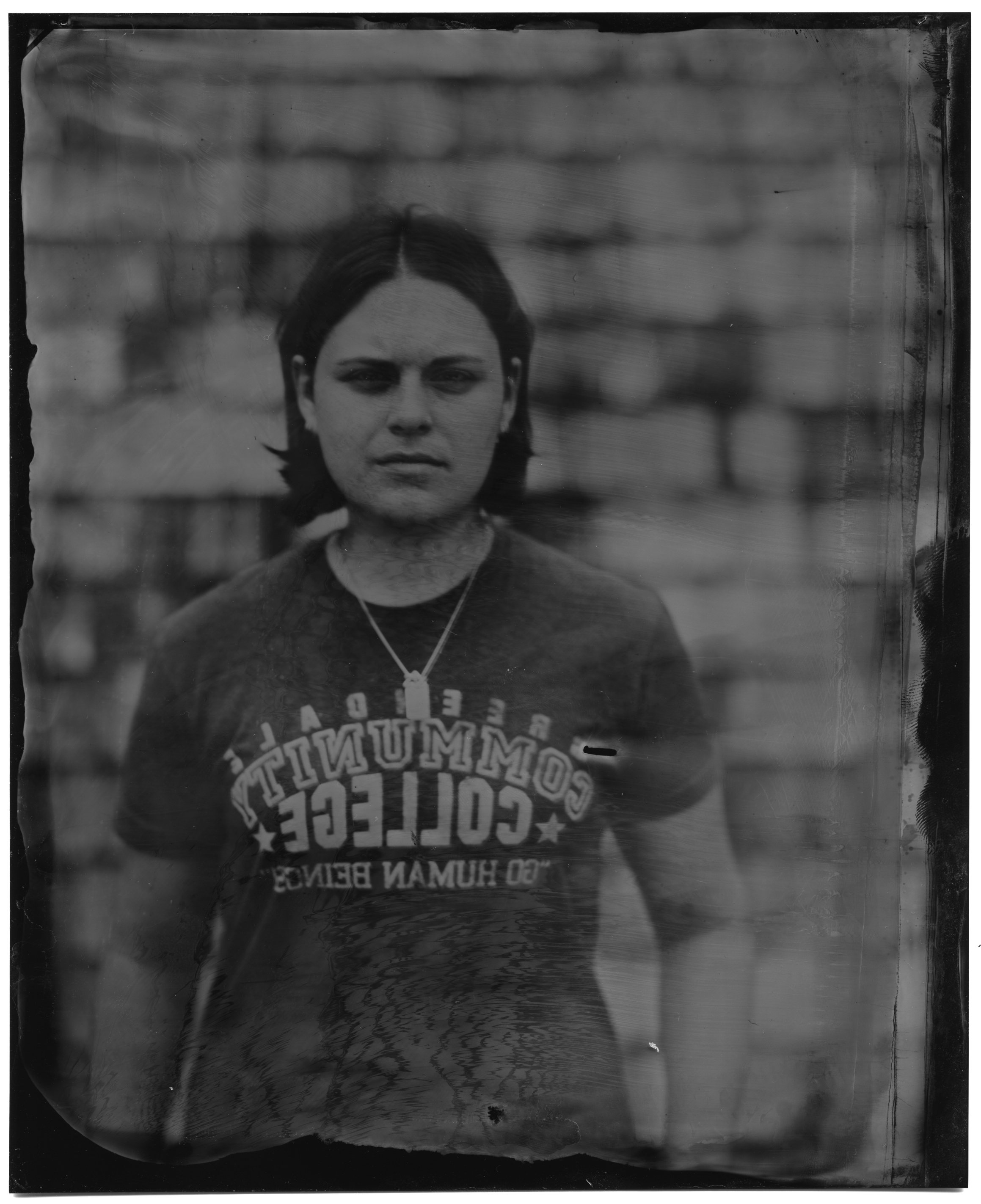
Portrait of Sarah 8×10 Tintype Dagor 8 1/4″ 12 Seconds @ F 8

One thing that was going through my head lately as I embraced the Wet Plate technique, was how does it fit in the “big” picture of photography? Why would one do this whilst the look can be easily replicated in Photoshop? I’m sure the wet plate practinioner just gasped, but really, it’s a lot of work and commitment to make wet plate collodion photographs opposed to running CS6 loaded with a some NIK filters. There are many reasons to do Wet Plate all digital joking aside. For those of us who like to stain your fingers and dig into the process, it takes you back to a humble, hard and complicated era of photography. Think of it as a way to walk in your Great, Great Grand Daddy’s shoes. (I’m not implying my lineage includes a photographer, as far as I know, aside from Uncle Harold, I’m really the first to embrace it). I made it hard on my self, going for 8×10 instead of 4×5, my images took twice the dexterity and acumen to accomplish a good plate. I like to ride a bitch however; I made two 4×5 Ambrotypes and switched over to the Deardorff. Jill also shoots with a Deardorff, and it is a choice camera to work with. Darn thing is solid like a Sherman tank (and just as heavy).
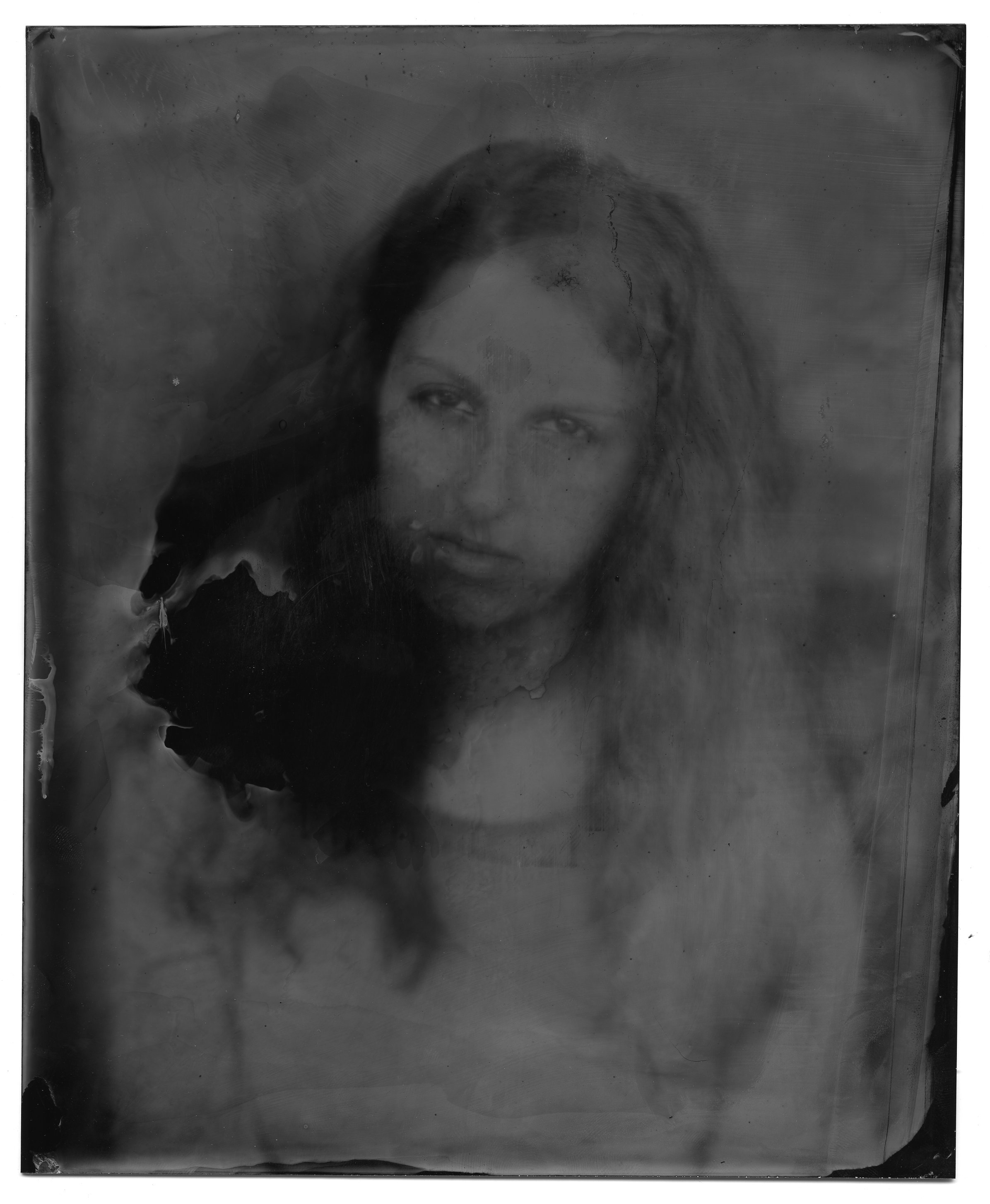
Portrait of Bari, 8×10 Tintype, Kodak Commercial 14″ 10 Seconds @ F8 Note the bad pour of developer that caused the black splotch.

A small concern about Wet Plate is its look. It attracts and scares me at the same time. It’s a look that you can point your finger at and say, “ohh wet plate, cool”. Jill did mention the ability to use watercolor pigment and a few other tricks to own your image more than just executing a great plate. Niles was using an old Dallmeyer brass lens with out a shutter, just timing his shots the old fashioned way, removing the lens cap and counting “one one thousand, two one thousand, three one thousand”. Throw precision away with spent developer, because Jill’s count was different than Niles count and I used my handy timer from my view camera kit. See, I learned view camera from Gordon Hutchings who learned from Morley Bear who are F64’s at heart. I’m a bit of a zoney, for better or worse so I found some of the wet plate technique haphazard and random. The look however is ingenuous to the technique, and that is where I have a hard time swallowing the process. This may be the key, process. Wet Plate is thick with process, control of the chemistry, effects of contamination, and also long exposures. The portraits taken during the era of wet plate were all almost somber and dour expressions. You can’t hold an ear-to-ear grin of a smile for 20 seconds. As a wet plate subject and to record a sharp face you must relax your muscles and be very still. The results are a serious subject. Landscapes tend to take on a pictorialist feel, and again, slow shutters speeds make for odd bedfellows including foliage in the wind soft, water amorfourous and action blurry. Nature of the beast when you eat shoot at ISO 6.

Portrait of the Incredible Mya, 8×10 Tintype, 14″ Kodak Commercial Ektar 10 Seconds @ F 8

Would I switch to this workflow and shoot a project with it? I’m going to say the answer is no. My reason is that I need to concentrate on the subject and executing the project as a whole. My current project, Battlefield Cant has already begun with Ilford FP4 8×10 film, I can’t switch now. And even if I did, setting up portable darkrooms and maintaining the chemistry in the field is way too invested for the return. That all being said, would I shoot wet plate again? Yes, it is an honor to shoot wet plate as our photographic forefathers did. Wet plate is complicated and the results somewhat unpredictable, and that may be it’s joy.

JIll Enfield demonstrating coating technique. Note the portable tent darkroom.
Fuji Xpro 1, 18mm Lens post process NIK Silver EFx Antique Plate II Filter.

Aside from learning the wet plate technique I got to cover some new ground. Because the class attracted seemingly eccentric and cool devotees I got to practice 8×10 Portraiture. I really cannot take a photo of a mundane person; I need some style or something strong inside a person to capture. It had been bugging me, how do you capture a person with an 8×10 view? Doesn’t the camera and film holder come between you and your subject? Square up camera, focus, place subject, compose, focus again, hold really still, insert film holder, and make exposure. Daunting right? I worked through it, I asked my subjects some thing cheesy but effective, I asked them to hold really still and look into the lens while telling the camera a secret, using telepathy of course. The results on several were quite compelling. Brenton Hamilton’s portrait is a favorite of mine. Photographic opportunism presented itself when Joyce Tenneson paddled up in a kayak to where we were set up on Day 4. Once again, that creative cauldron of Maine Media Workshops tests you, makes you “go up levels”.
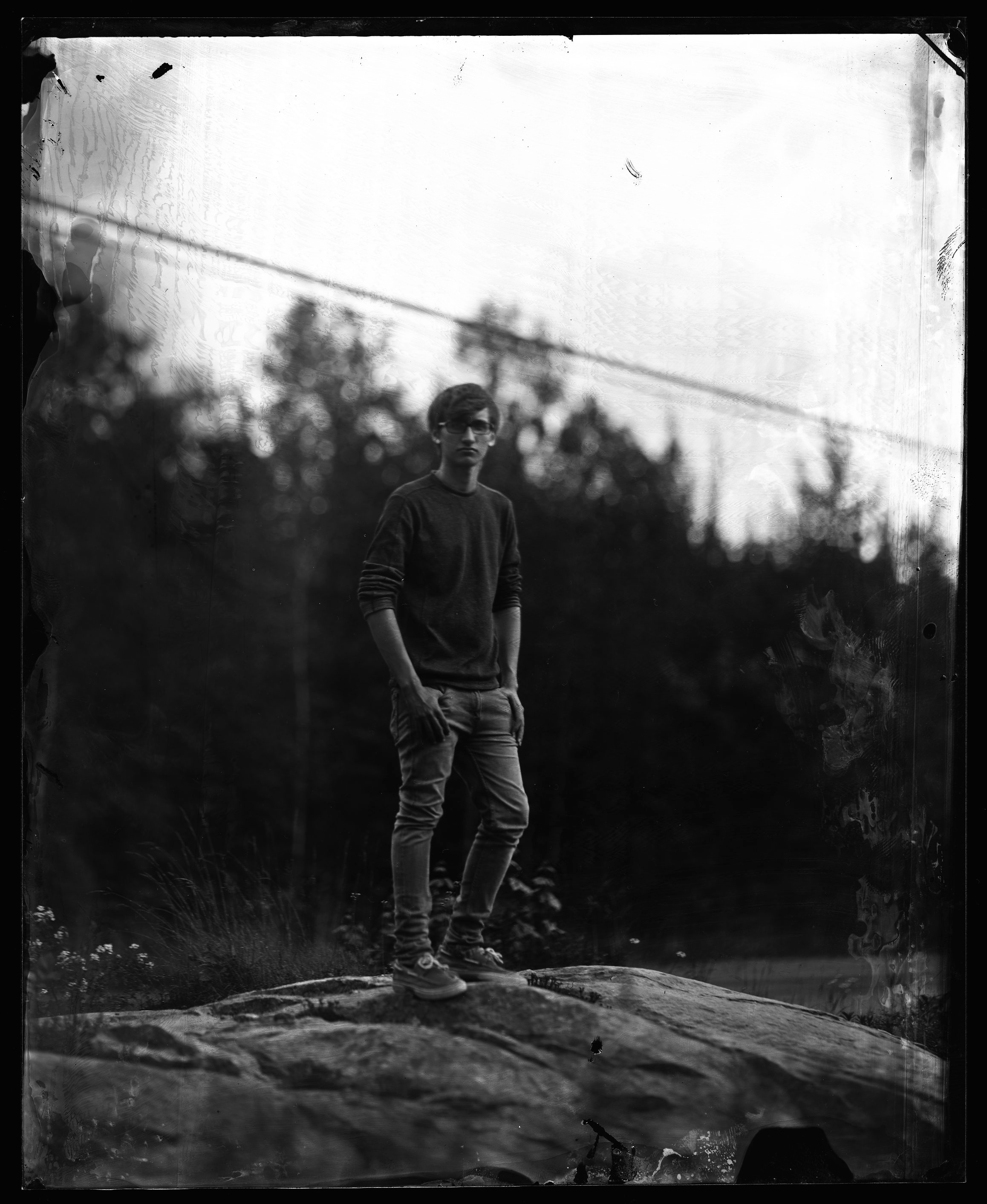
Portrait of Jesse 8×10 Ambrotype Dagor 8 1/4″ 8 seconds @ F 11

Life is but a dream with Joyce Tenneson kayaking in Rockport Maine. 8×10 Tintype, Dagor 8 1/4 lens 12 Seconds F6.3

I’d like to thank Maine Media Workshops, Jill Enfield and my classmates for wonderful week of photography.

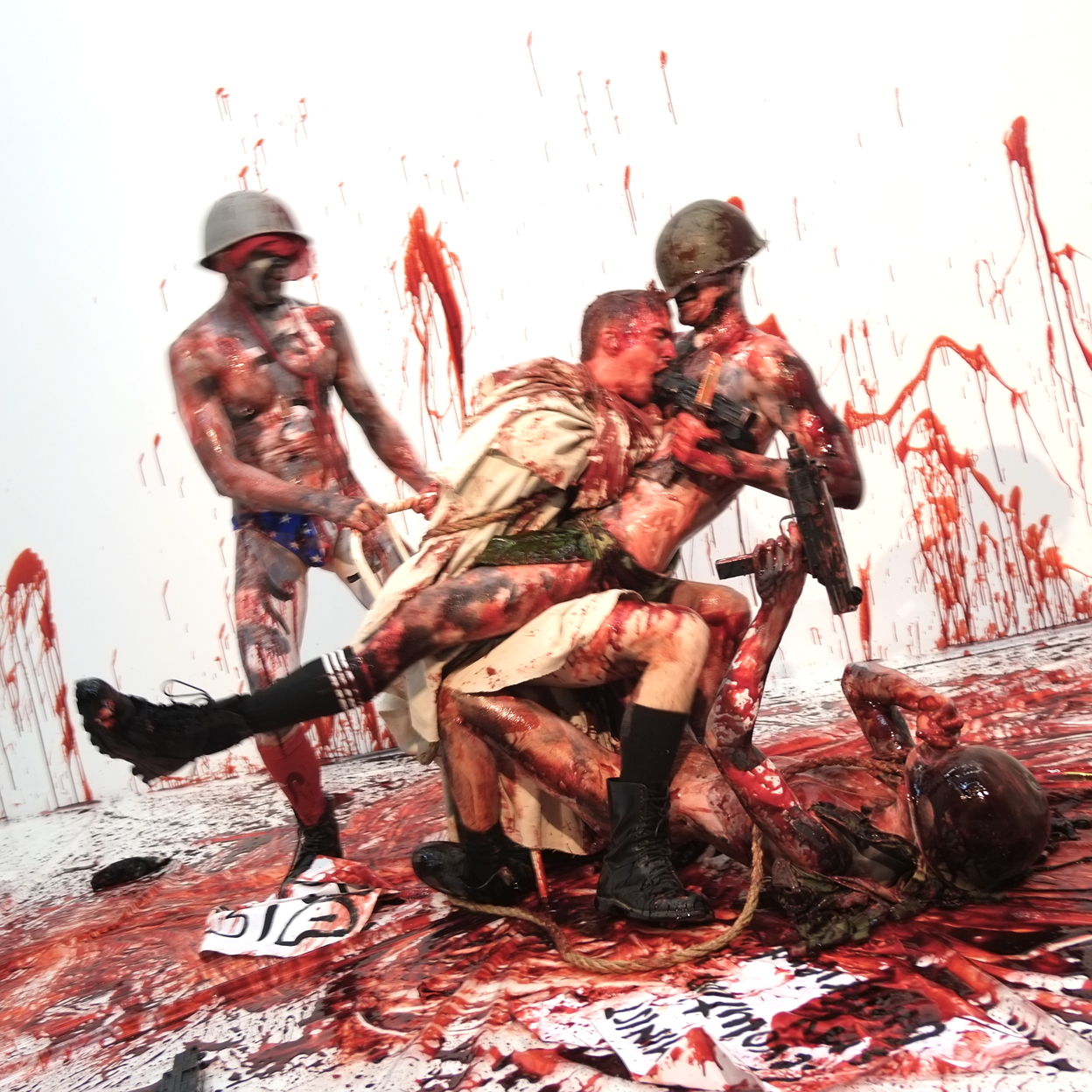
Blood Bath in NYC courtesy of Bruce LaBruce

Just when I thought I was through photographing edges of the human race, Barbara suggested we head over the Hole NYC for a performance piece and book signing by an artist Bruce LaBruce who I wasn’t familiar with. A fast googling brought me to his wiki page and I was intrigued for sure. He’s a Canadian born multi disciplined gay pornographer, photographer, and writer. What caught my attention is he’s working in polaroid whilst shooting contentious set up scenes.

Before and after staging of performance.

Shock seems to come natural to Bruce, he softly directed the models and injected the signs and queued fonts of blood from his ultra fem-boy assistant. Wielding a Polaroid 600 camera, a base model with hardly any overrides, he strategically shot, signed the photo with a sharpie, and tossed his polaroids to the side for fem-boy to collect. The words on the signs seemed at first to be a standard progressive mantra but then as you start to really latch on to the slogan, its just “off” some how. It’s like laughing at a joke you don’t really get. Makes you think, and then just like that, another bucket of stage blood splatters on the victim-model, the crowd roars, and the antagonist-models contort in delight. Bruce, he’s just shooting, signing and loosely orchestrating the spectacle.

Paraded around The Hole NYC main gallery.

Victim is secured.

All the while a DJ pumped obscure dance music with a sometimes pop and often industrialized beat. Loud, expansive and contained in brilliant hi-key white, the Hole NY shook to audible and visual mock violence. It was perfect.

Bruce LaBruce Pieta 2012

Bruce in action with his Polaroid.

Fem-Nazi Madness

We hung out late afterwards, as people from the audience volunteered to be victimized the crowd slowly shuffled out. There was a small sign that promised signed polaroids for $5 each. I was incredulous to this as nothing in NY costs five bucks that’s worth a damn, aside from a bagel or a 4 block cab ride. Bruce’s work was taped to a brick wall, and in the end, with just a few gallerists  present, fem- boy let us pick out 4 polaroids. Barbara put them in her pocket book, I slipped fem-boy a Jackson. Our photography collection just took a turn for the better, I’m going to treasure those polaroids. They will remind me that the edge of the human race is alive and well.

Polaroid 600 Film recently shot.

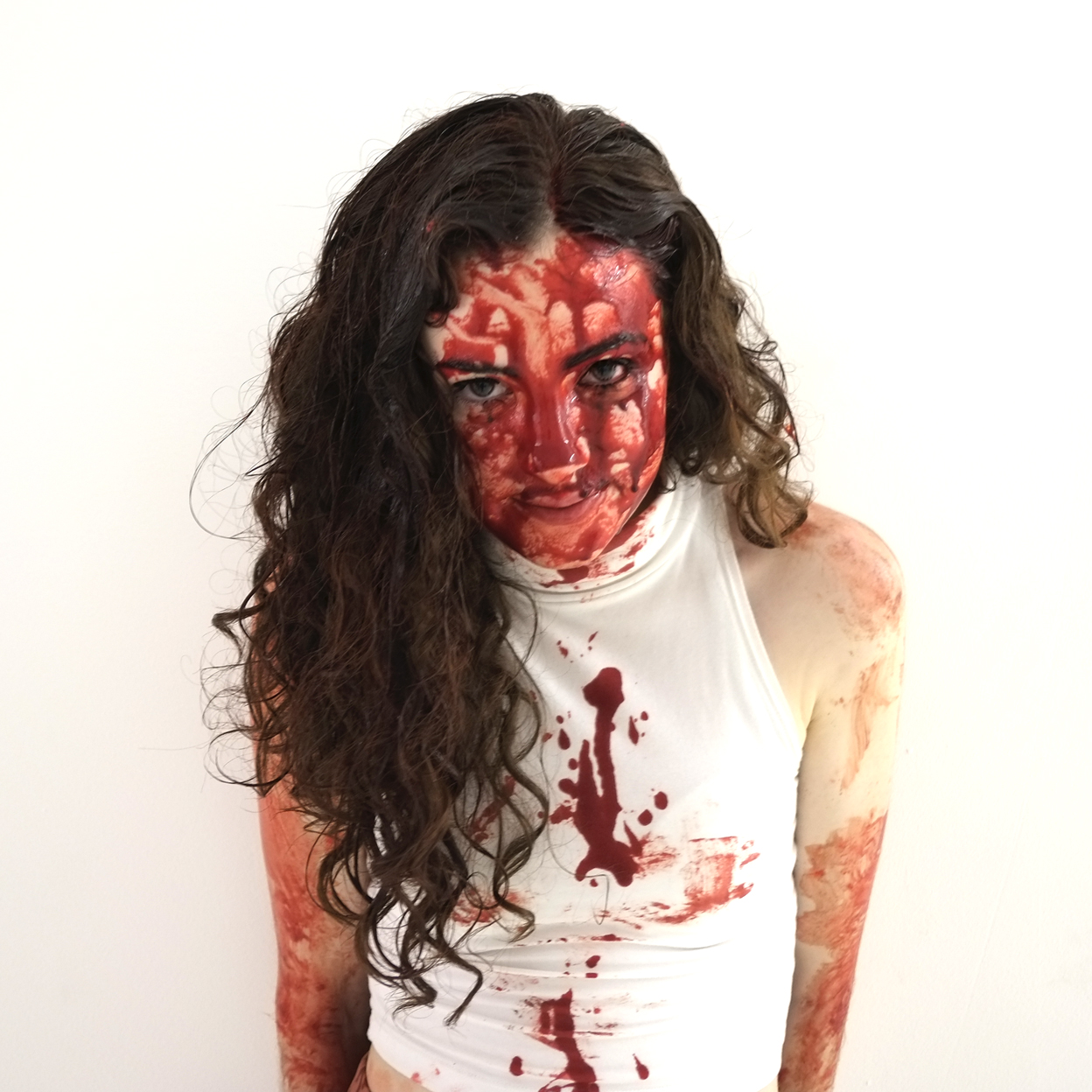
a girl from the audience is targeted (and she loved it).

Later on, two blocks north on Bowery at Gemma I chimped my X Pro 1 to see what I got and the results gave me photo-butterfly wings feelings!  At the early point of the performance I set the camera exposure compensation to +1 stops which kept the walls white (until they became blood spattered of course). ISO setting was auto-1600 and I shot wide open at f 2.0 with the 18 mm which was perfect, allowing me to frame the whole stage from my vantage point. I shot fast and furious, to match Bruce’s orchestrations. Twice, I switched over to video and caught a movement of live action. The thrill of  photographs well caught was evident. I was excited by the shoot, but alas, it wasn’t mine. It was purely Bruce’s and myself and all the others who were shooting, video taping… they got something good, something exciting too. With all the smart phones of the 100 or so onlookers I imagine twitter, facebook and instagram must have been humming or as they say in the new digital vernacular, “trending” (I can only imagine the comments). I ordered the steak, rare. It seemed the only thing I had an appetite for after the performance.

After the buckets of blood were all done, Bruce slowed down and took more time directing.

Bruce had no signs saying no pictures. The spectacle was ours, shared by Bruce’s work and his decision to allow the imagery in an ultimate form of sharing, unrestricted access to his Bowery blood bath for all to see. Suspect Photography applauds Bruce LaBruce and his open-source performance art.

~David Brommer

Zen, Zones, and Focal Lengths are now the new drugs.

Fuji X Pro 1, 18mm, Snapseed processed

The sublime pleasure of seeing space surrounding the self as a trained photographer is our greatest gift and pleasure. Shape, lines, shadows, highlights, objects, nuances of patterns, both similar and interrupted, the delicate ballet of balanced forms, transitions of contrast defined in air and matter while viewed in whole, then fractured and selected inside a frame, bounded by our souls perspective focal length. It is sublime when in the zone, when all those take prioritization in you vision, the camera clicks, and its done.

Fuji X Pro 1, 18mm 1/200 f 8 200 iso jpg

The sometimes and not-often secret peak of the photograph making experience is felt in a tremor of the shutter release and can be drawn out for 3 seconds or more after the exposure, this is the satisfaction sensation. You did it. You got that shot amongst a special plane of non-interest.

Fuji X Pro 1, 18mm Snapseed processed

Shooting and seeing is akin to seeking. What it is you seek may not be known to you, walking about armed with your camera and having no particular agenda. Space will reveal what is interesting, time will put your body in the right temporal position and you just might make an interesting photograph. Or you can exert heavy control and manufacture the perfect storm to capture that superlative image. Shooting in a studio makes you the great creator of light, like Lucifer and Prometheus you can encase your image with brilliant photons, be the master of the subject and set. Photographers that create in a studio assume the aspect of gods.

Fitness bill boards

Fuji X Pro 1, 18mm Snapseed processed

How can you shorten the length of mediocre image making from the creating of greater images? There is one way, and that is to make lots of images on an almost daily basis. Live in the margin of seeing, be ready to take the viewfinder as a macroscope for living in this space, here, breathing these sights, and feeling those reflections. Incorporate “often” as way of answering the question, “when do you take pictures”. Raise the camera and make exposures often.

Fuji X Pro 1 18mm 1/30 f 4 iso 400 jpg

A click is a drug and the resulting image the high. Multiple clicks lead to visible euphoria and in that fog of stimulus better images lie. Do it enough and you will find a reliable friend in f8 and a fickle friend at f 1.4. Stay shooting and 1/15 second all of sudden seems like a month. ¼  second and a year shoots by a like the Silver Surfer on speed.

Sean Kernan told me Tidd Hido said, “I think I’m addicted to the feeling of having just taken what I think is a good photograph.” Feed your addiction and makes lots of images. Embrace the “studium” and don’t bogart the camera.

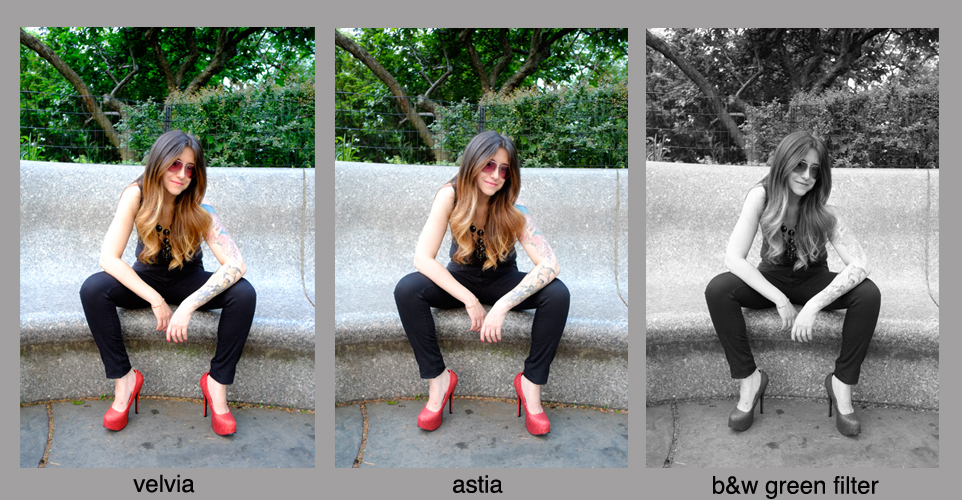
Film Simulation Modes on Fuji X Pro 1

18mm 1/30th at f/2.0 B&W r ISO 800 B&W- Y JPG

So I’m old, I cut my photo teeth on film, I predate digital photography. Back in the halcyon days of film the choices were plenty and you could match a film to your style or the subject. Kodak was king, but then in the late 80’s Fuji Film came out with a highly saturated slide film (e6) called Velvia and the game changed. Fuji roared into the market and just kept coming up with innovative professional emulsions that defined the film mindset and challenged Kodaks hold on film. These Fuji films all had a certain look to them, some subtle and some bold. Velvia possesses a super saturated slightly contrasty look that became the darling of nature shooters. Provia was the “go-to” film for product, commercial and general use, while Astia and its lower contrast smoothness hinting with a touch of warmness was perfect for portrait and fashion work. These were just the slide films, in the print world of negatives (c41) you also had a bevy of specialized films such as Reala for portraits, Press film for journalists (very pushable to higher iso’s), and some great b&w choices. Neopan 1600 was a wonderful high speed fine grain film, and I still shoot with Across 100, a smooth and fine grain emulsion that produces lovely prints.

Digital Photography is very versatile, in post  you can easily adjust the look of your image to match the attributes of these films. In many ways, the art of matching a film emulsion to your subject is lost these days but was crucial back in the day. The X Pro 1 however has something very cool that us old shooters dig, it’s called “Film Simulation Modes” and in the menu we can bias the camera to shoot like a particular film. I teach a class called, “finding photographic style” and I encourage people to work with in-camera digital styles to fine tune their vision. Shooting this way forces you match subject, genre, and style to a look, easily achievable with a film sim mode. The X Pro 1 takes it even further and offers a film sim bracket mode. You can assign three films and take one shot and the camera gives your three images each with a different film simulation. It’s a bit slower to work this way, as the process time takes few seconds. But the results are fun and shows you the comparison between three types of classic Fuji emulsions.

Barbara models for me at Central Park trying out different film sim modes.

The X Pro 1 offers you a choice of Provia (standard), Velvia (punchy & saturated), Astia (soft), Pro Neg Hi (contrasty), Pro Neg Standard (great range of tones), Monochrome (b&w), Monochrome Y (Yellow filter for contrast), Monochrome R (Red filter for higher contrast, great for clouds), Monochrome G (green filter for smooth skin tones), and Sepia tone (warm old feel).

35 mm lens 1/4000th at f/1.4 Provia ISO 200 JPG

I have been shooting Jpegs with the X 1 Pro on account of no RAW support from Fuji yet, so I haven’t been able to test how a RAW image would work under a film sim mode. The merits of this feature are certainly debatable, but I stand by my statement that it allows you to instantly “own” your image in a unique way. I would advise you to explore these settings both in color and b&w. You just may be surprised at the path this film simulation takes you, or at least get a warm fuzzy feeling now that you can shoot with Velvia again… sort of.

~David

Rangefinders are less jerky

Malaysia Beef Jerky Co.

Mirrors slapping around cause vibrations, and vibrations make for less sharp images. Less sharp images make for less of a good photograph. I do like to see creatively blurry shots, but soft is something entirely else. Rangefinders do not use a mirror, and can be shot at very low shutter speeds hand held while maintaining good sharpness. It’s one of the advantages rangefinder and mirrorless cameras have over their SLR younger brothers. Another advantage is since there is no mirror, the rear element of the lens can mount close to the film/sensor plane making retrofocus lens design not needed. This allows for better edge to edge sharpness. Seems like it all comes down to sharpness, but actually it allows for great versatility in shooting in the neighborhood of  low shutter speeds (below 1/10 of a second and the vaunted 1/4 of a second ) where you can catch moving subjects and sharp static elements.

Hand Held 1/18 F 8.0 ISO 200 JPG

There are a few tricks you can do to increase stability, but first lets talk about what shutter speed you have to start paying attention. There are image stabilizers in many lenses and camera bodies nowadays. Olympus, Sony and Pentax integrate them into their digital bodies, while Canon’s IS (image stabilization) and Nikon’s VR (vibration reduction) are built into the lens. The rules with an SLR is that  you need your shutter speed to be what your focal length is. Thus a 210 mm lens needs a 200th of a second shutter speed. A stabilizer lets you cheat that by 3 stops, thus 200th to 125th to 60th (hello 50mm lens) to a 30th of a second. Pretty darn good when shooting with a Telephoto lenses that can really benefit from stabilizer tech. Most people can hand hold a 3oth of second as a matter of fact, It’s pretty safe to hand held at 1/15 of second with an SLR. Lower than that, the mirror can cause vibrations as stated earlier. 1/8, 1/4, even half a second are very difficult are difficult or impossible to capture an image sharply.

Being able to shoot at low shutter speeds hand held can be an art all to itself. You really do have to achieve a stillness akin to zen. Inhale slowly, have the camera strap wrapped about you so that the camera is taunt, slowly release the shutter with out jerking the camera, hold your breath, utter a word to the diety of your choice, and make the expososure.

1/4 s at f/2.0 B&W r ISO1600 JPG lit by a single table candle

You may have had 2 tall lattes and are now quite  jittery or perhaps just really excited about what your photographing (yea, I have been on a few Suspect  shoots back in the 90’s where I was shaking like a hound dog passing peach pits during the studio session). In this case, bump the ISO up two stops to be sure. The Fuji X Pro 1 is exceptional at high ISO shooting. If all that fails, then find a hood of car, mailbox, pole, or something suitable to prop the camera on just to give you a steady edge. The best of the best can handhold a rangefinder for 2 seconds and still achieve super sharpness. Me, I’m good for a second. But then again, it depends on how many espresso’s I had at dinner.

Shoot well, shoot sharp, and shoot stable fellow Suspects,

~David

Fuji X-Pro 1, or “The Camera I have been waiting for my whole life”

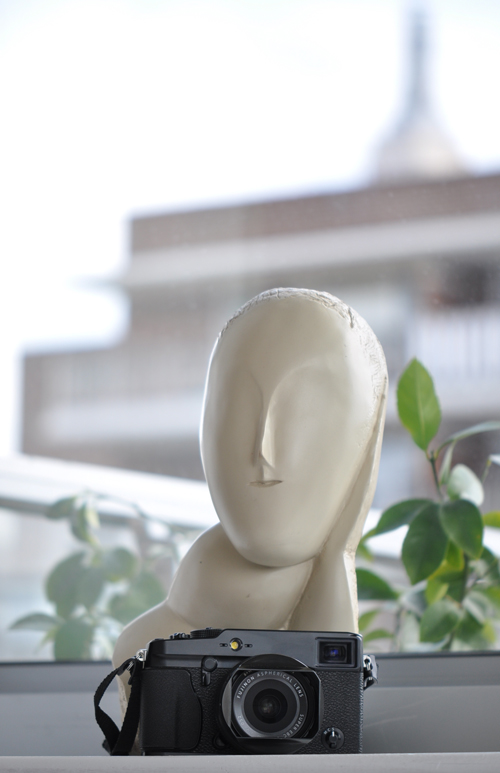
xpro1

Last week, I got my new Fujifilm X Pro 1 camera with the 18 mm f 2.0 lens. This was a big move for me, I haven’t bought a new camera for many years, as a matter of fact, I think my last cameras that I bought were an Olympus Pen F vintage camera, and before that, the Deardorff 8×10. I would like to note, that various camera companies have been sending me cameras for years to test and learn so that I may spread the word about how to work them. I have put through the ringer Canon, Nikon, Olympus, Pentax, and Leica cameras. Also I have used extensively all the Pro Fujifilm Dslr’s with the exception of the Finepix S5 (I love to shoot with the S1, S2, and S3 watching the evolution from behind the finder). So I plunked down hard earned green backs on this not so little jammer. I wanted to own the camera, because I felt strong about it. The design and quality that is something that has been long in the waiting. If I were to compare it, the best comparison would be to Leica M 8.2 but that would be unfair, and to compare it to the Sony NEX system or Panasonic G3 is also a stretch. The feel of the camera mostly reminds me of Hasselblad X-Pan with out the weight. Actually I can feel the DNA of the X-Pan in the X-Pro 1, after all, Fujifilm manufactured the Hassy X-Pan and it’s lenses. You could even find the camera under the Fuji name of TX (The Xpan got an update to a Mark II in 2003 being called the Xpan 2 and the Fuji’s model the TX 2).

Hasselblad Xpan and Fuji X Pro 1 side by side

If Fuji making the vaunted Hassy X-Pan sends shivers down your spine and you didn’t know that Fuji is actually serious about pro cameras then now you know. Fujifilm is way more than just film and a lab company. They are committed to professional image makers, always have been, and always will. The X-Pro 1 is proof of that.

So exactly why am I so pumped about this camera exactly? Remember, I dropped over $2200 for it. Form and performance seem to go hand in hand with the X Pro 1. The camera borrows much from the X100 which was released a little over a year ago. Indeed, its a interchangeable and beefed up version of the X100 with lots of enhancements. The one thing it does better and were all happy about, it does focus faster than the X100. While I never had much of an issue with X100 it is faster and faster and more responsive it better.

What really sets this X Pro 1 apart from all the other mirrorless cams, is the hybrid viewfinder. If you’re not familiar with the way you see your image as you compose, there are two ways. The OVF or optical view finder and the EVF or Electronic View Finder. OVF is analog, your looking through glass and the EVF is akin to looking at a magnified tiny tv scene of your image. The finder can either work as gorgeous optical finder with projected parallax corrected framing lines, allowing for a host of info to be shown or not shown (everything from WB to battery charge, to meter mode, film sim mode, exp. comp, frames remaining, grids, levels, focus points and more) or as a EVF. Leica users will delight in the way to change the view from OVF to EVF, a lever on the front of the camera reminiscent of the Leica lever for changing framing lines to focal lengths toggles back to enable either view mode. Its a pleasure to look through a true optical view finder, you can see outside the frame of your scene (SLRs have trouble with this, they are view finder wysiwyg) anticipating when something is about to move into the composition. The EVF however is a bit contrasty yet clear, when the camera is in macro mode, the EVF automatically turns on and you have to use it. A clever way to circumnavigate the tenant that rangefinders are poor at macro. The Sony NEX does have a better EVF system, but the bright OVF trumps them all and is one of the pleasures of using the X Pro 1.

Its not a small camera, it has a modern look and lines, its sleek and all black. It is light, but tough since the chassis is magnesium and the body is wrapped in vulcanized leather with a rubber bumper grip. The X Pro 1 feels really good in the hands and around the neck. I switched to a Domke gripper strap, the supplied strap slips off the shoulder easy. There is also a grip available which I am waiting for the shipment. The 18 mm f 2.0 lens ships with a lens cap and a special wide hood and rubber cap. I lost the hood lens cap at a  Yankee’s game last week, so now I’m running it with a B&W 52mm UV filter, the hood and good to go. I’ll be posting more sample images here on Suspect Photography as I bond and become one with this camera.

David

Damn, thats a nice view, it’s burning. Beautiful!

Sitting at the table overlooking Chelsea in NYC my fingers are dancing over the keyboard with a life of their own it would seem. I’m about to slug back my cup ‘o joe and ponder the words I’m about to throw into the web, in the hood of the blogosphere and wonder what I do believe every blogger who came before me thought, “is anyone going to read this? give a rats ass about the posts? what am I going to actually say?”. Perhaps I would be better off just shouting from the balcony. Considering its a cold spring morning and I’m in my underwear, it would be best to continue my current course and pour another mug of joe.

Lets get down to biz shall we? What do I have to say with this blog? Here is where I’m going to go with this. A commentary on photography. This blog will review gear, point out important photographers, host new photos, and be a sound board for what goes on in my head focusing on creation of photographic imagery. Two things have really been on my mind these days-months-years and I’m hoping that this electronic form of communication will let me unburden these thoughts and get feedback from those that just might give a crap.

All right-y Time to ROCK, do this… Lets get what’s in the head into digital distribution. Stay tuned… turn on… feeeeeedddddddd…..