Suspect Photography

words and images from david george brommer

Category: Finding and Developing Photographic Style

The Tuscan Darkroom and Observations in Film Based Photography

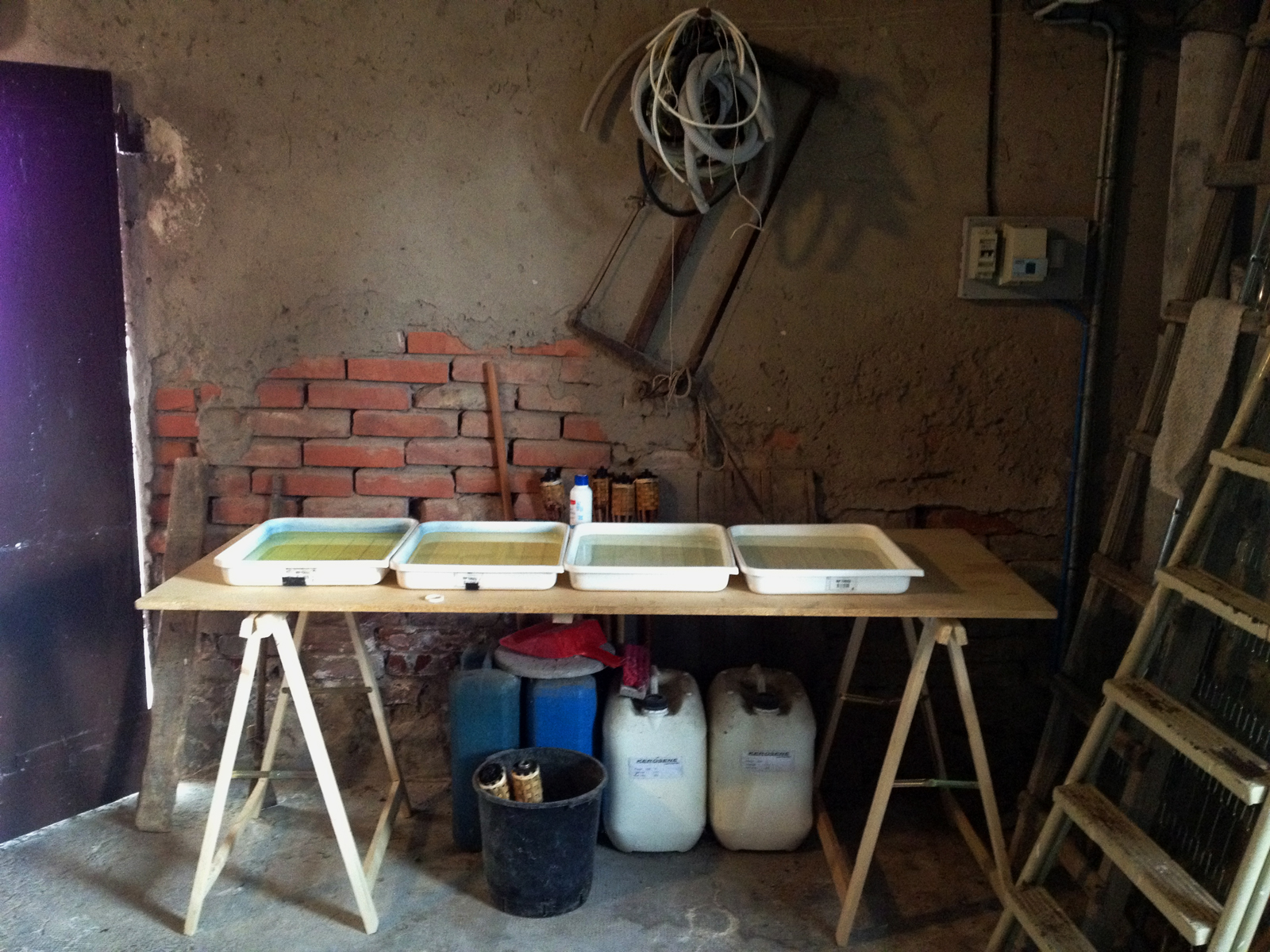
The classic rustic darkroom set up in the back workroom of the Tuscan home in Terontola, next to Cortona in Italy.

The classic rustic darkroom set up in the back workroom of the Tuscan home in Terontola, next to Cortona in Italy.

There is a sublime pleasure when you practice the core of photography that includes manual film cameras, red safe lights, and wet chemistry. In today’s parlance you call it “analog photography” and that while accurate, lacks a certain charm. It would be easy for the younger “generation Y” that has grown up in the digital age to dismiss the non-digital analog as an anachronism. Way too much effort to get produce an image. In practice it’s almost laughable when a well-done Instagram feed is not complete without apps to mimic the vagaries of film properties. With out understanding the nuances of the film and dark room to realize your images I often wonder what effect this will have on photography as we know it. Will masters of photography arise from the new generation? Will they create work worthy of Mapelthorpe, Avedon, and Witkin? Time will tell, but I’ll tell you what, with out the discipline of film it will be harder for Gen Y to attain such elevated image making. Let me elaborate on why I believe this.

I’m a late Generation X photographer, the last generation to have access to the core of the medium. In high school my yearbook was assembled with black and white photographs that we, the students printed in a small, narrow darkroom with two enlargers. The art department didn’t have one (I heard in the 70’s they did) and you had to be in the “year book club” to have access. My first assignment was a wrestling match, and I completely botched loading the film into a Nikon FM2. Eventually I learned how to load a 35mm camera and started taking photographs of my NJ suburban life; Milton Lake down the street, a local cemetery, my friends cars and more of what I was surrounded by.  You were limited to 24 or 36 shots per roll of film, and there was a great chance of you messing up somehow, in the early days of film photography your first few rolls of film were often filled with chance and mistakes. 

Chemistry, Film Processing Tank, and Film. Going classic with Kodak Tri-x developed in Agfa Rodinol.

Chemistry, Film Processing Tank, and Film. Going classic with Kodak Tri-x developed in Agfa Rodinol.

35mm film core photography workflow is pretty much performed this way since it was invented in 1923; expose film, transfer in dark the exposed film to a film developing canister, process film, make a proof sheet, pick and chose which to enlarge, and then make prints. This is all done primarily with three baths and a good wash. Exposed film and paper are put in developer, then a stop bath, followed by a nice dip in the fixer. After the stop bath, and mid way in the fixer, you can turn on the lights and get a good look at what you made. This process allows for stylistic choices such as film stock and the developer. The print can be luxurious with fiber paper, or a easy to use (but not archival) resin coated paper. 35 mm film can safely be enlarged to 11×14 and even 16×20. Larger printing sizes can be done, but expect substantial grain to be introduced to the look.

 Spark from the Seattle Suspects

You can become very exotic when it comes to mixing chemistry, often a photographer will entertain one type of film and process it the same way throughout their lifetime (and certainly the duration of a project). During the 1990’s my Seattle work was all shot on Kodak Tech Pan and developed in Agfa Rodinol. Neither the film nor the chemistry is available now, thus that work created then is considered vintage. This is something the photographer has to get used to, our selection of paper and chemistry is not eternally supplied. I recall selling the great American photographer George Tice the last supply of Agfa Portriga paper B&H had in stock. He was simply devastated! But then George adopted Ilford Galleria FB Warmtone and all is well again.

tuscan print station 

Another interesting aspect of the film photography is waiting to see the image sometimes days or months. The cool part of the digital photography and the ability to instantly see your exposure has a profound impact on your vision. With a digital camera you can instantly know if you nailed it or not. Shooting film, often times you can forget entirely what you photographed only to be surprised later when the image turns up on a proof sheet or by holding the negative up to a light. This fundamentally adjusts the “accident factor”, that which happens in an unpredictable manner and effects a expansion on your creative skills. When this chance opportunity occurs you might also be benefited by a stylistic leap and follow something that is entirely unique to you. Not to say you can’t have an accident occur in digital photography, but film photography is more disciplined in execution and easier to mess up! Don’t forget, digital seeks to emulate it’s grandfather and offer you control of effects and looks that occur in film photography easily, film photography does that inherently, but it takes more coaxing.


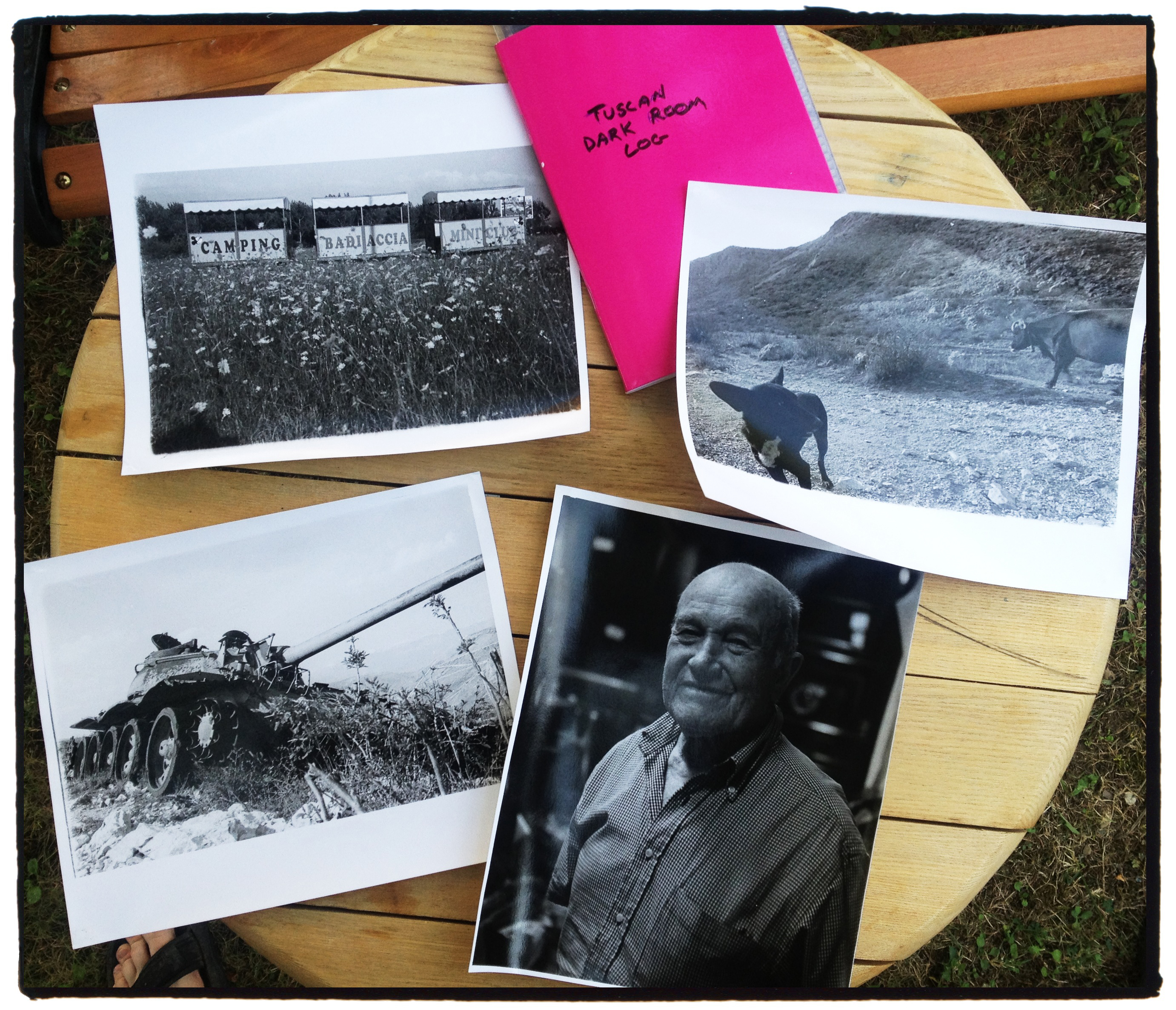
Prints made in Summer 2014. Nicola Tiezzi and I spent a night in the Tuscan darkroom till the wee hours printing. I made the portrait of the old mad and the camp grounds, while Nicola made the tank and the dog and cow prints.

Prints made in Summer 2014. Nicola Tiezzi and I spent a night in the Tuscan darkroom till the wee hours printing. I made the portrait of the old mad and the camp grounds, while Nicola made the tank and the dog and cow prints.

I think the point I’m trying to make is that everyone should practice film photography in one way or another. You can’t go forward with out looking back. 

In the next post, I’m going to elaborate on the actual film camera. As always, stay tuned photographers.

~David

The Summer Project: Back to the Analog 1950’s

NikonGear


Every summer I self assign myself a photo project for my August Tuscan vacation. Sometime in May or June I start to think about what I’m going to do and since I have been going to the same spot for 12 years straight now, in the past I have shot 8×10 landscapes (twice), 4×5 landscapes (and made 4×5 cyanotypes under the Tuscan sun), a study of the Terontola house with a Hassalblad (for a handsome book), Instant Italy (all shot with Fujifilm Instax), Olympus Pen FT half frame, and many digital photographs including Italy Looking Up (shot with the Leica M8.2). The past two years I have enjoyed using the Fujifilm Xpro1 extensively and showed them in this blog.

This year I was in a quandary. I considered doing portraits, but truth be told, the effort to work my Italian subjects is too daunting for a vacation, I enjoy the summer work because it shouldn’t be hard, it should be completely relaxing. Over the years I have set up a primitive darkroom in the back of the house. Primarily for developing film and lately doing contact printing. I always dreamed of having a full force darkroom back there, since I have been darkroom-less in NYC since I arrived.

This week I have read two interesting web pieces about film photography. One about an Indian Photo Club dedicated analog film and the other from an old buddy of mine who has relocated Japan and makes a strong case for shooting film with personal reasons. Both of these musings have these influenced me, they got me thinking. I am not going to drone on and on about the film vs. digital argument. That’s moot, and I have done that already in my article “The Merits of Shooting Film in the Digital World” for F295. What got me was the simple joy of hearing a shutter click, and the feel of advancing film with a lever. Loading film, unloading film, and then loading film onto a reel and putting it into a light proof tank. Mixing chemicals, timing it all, reviewing the exposed negative up to a light, cutting the negative, and then lastly, printing the negative. Working in the dark, holding that finished print in your hands after it has dried. Showing the print off, examining the print and noting how you could have printed it just a little bit better.

It’s simply sublime. There is no substitute for this process. It is the essence of photography; skill, vision, craftsmanship, and art. It’s black and white, it’s subtle, and it’s shadows and highlights dancing on fiber paper. Even as I write this, I’m contemplating bringing the last of my marshals oils and perhaps, doing a little hand coloring!

I fired off an email to my friend Nicola, one member of the triumvirate that is behind Cortona On The Move, a photo festival that occurs in the summer months in Cortona, if he could source me an enlarger. He replied he had a cold light Kodak sitting in storage! Perfect, I love a cold light source, and better yet since the back room of the Terontola house is dusty as the days are long.

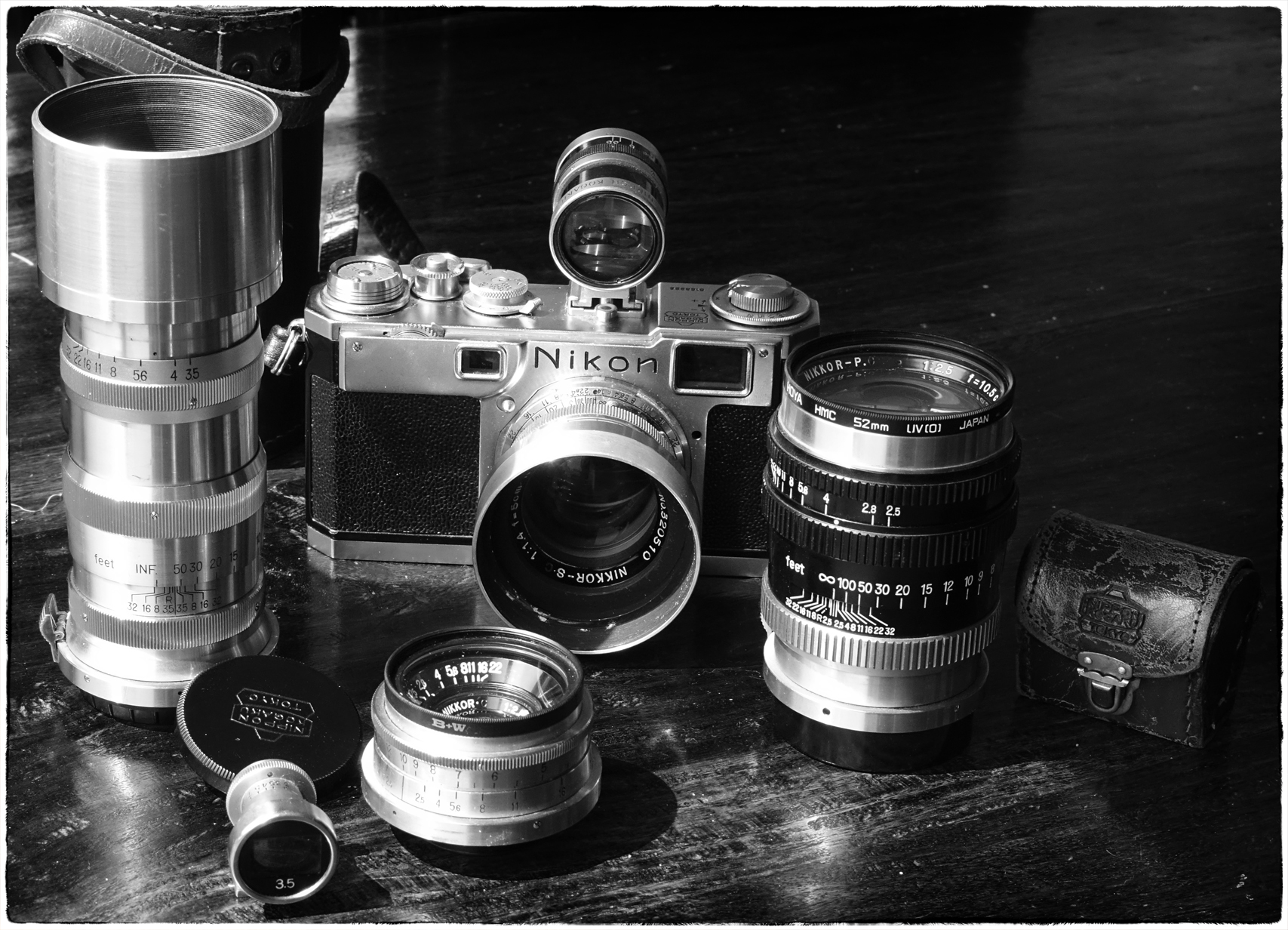
So this leads me to the choice of cameras. I have a nice collection, actually I pride myself on my camera collection. Since I’m going back to roots here, I think I’d like to keep it simple and that means lets forego large format. I’m thinking 35mm. And my favorite 35mm camera system I have is my vintage Nikon S2 rangefinder. She’s a beauty right out of 1953. Sexier than a Leica, made like a tank, and unlike the more popular Nikon F system cameras, the S2 is a rangefinder. For lenses I’ll bring the entire collection, which includes; a super duper sharp 50 mm 1.4, a great semi wide 35 mm f 2.5, a sweet portrait shooter 105 mm f 2.0 and then just for fun, a 135mm.

I can’t wait to shoot all day and print all night. So keep Suspect Photography bookmarked and I’ll be posting some classic photography during the rest of August.

~David


Environmental Portraits, Location and the Importance Of Background

Yesterday I went on a motorcycle ride with my outlaw biker brothers (and fellow photographers) out of NYC and into Long Island. I brought along my trusty Fujifilm Xpro1 looking forward to shooting some portraits during the ride.

I wanted to shoot pretty wide open to get a blur going on the background, but it was mid-day and quite bright so f4.0 was about as open as I could go. I also wanted to show off the bikes, so I would be further back then my normal portrait shooting distance, thus increasing detail in the blur. The background would have to be considered and thought out as importantly as the subjects. As a matter of fact, I can’t emphasize enough a good background! I like to treat my photographs in three layers, a foreground (in this case the front of the bike), the middle layer (the subject) and the background. I place the emphasis in portraiture on the middle and the background; they are certainly the most critical of the composition, and finding a good foreground being a bonus.

18 f 2.0 2500 sec f 4.0

18 f 2.0 2500 sec f 4.0

First consideration on the background is keeping the horizon in a third. Never ever cut the horizon in half! In this portrait of Joe Otto on his big 1100 V-Twin Cruiser I made sure I lowered myself to ensure the horizon was placed 1/3 to the top. Notice the pavement line that leads your eyes up to the center of the image, and also the blurry car in the far top left, centered between grip and mirror. These background details are tiny, but are elements that ensure the portrait is pulled off with a compositional perfection.Relationships of shapes in the image should also be identified and included, the shape of the headlight mimics Joe’s helmet, so the included that in the crop.

35 f 1.4 4000 second f 4.0

35 f 1.4 4000 second f 4.0


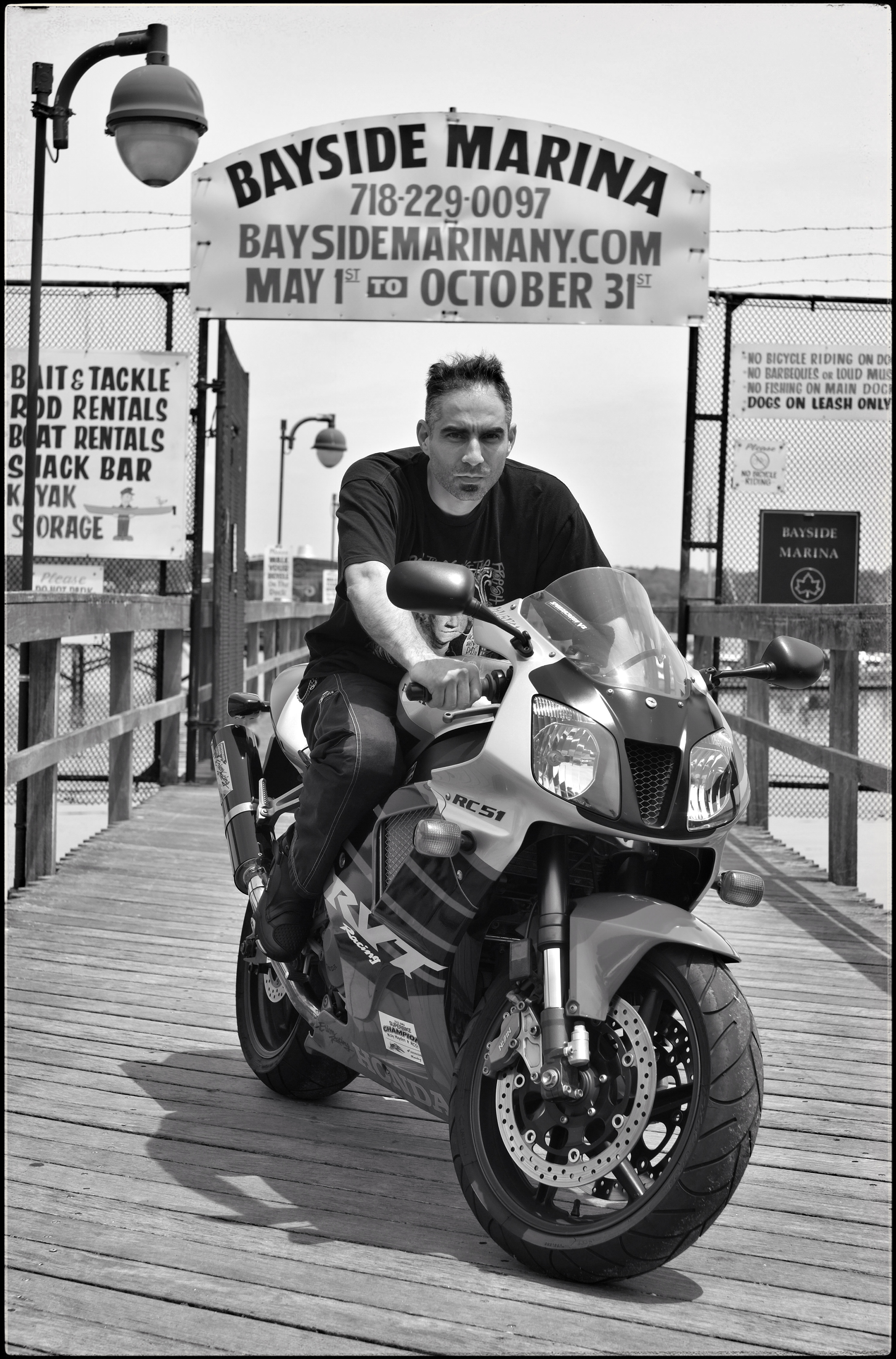
In this next photograph of the Kingpin I found a background that has strong elements such as the board walk planks and the sign. While composing the image I would use the Bayside Marina sign to frame Kingpin, while being very careful where the light fixture in the upper left would be placed. During the composure I then noticed the second light fixture and made sure it didn’t touch the subject. I was conscious of the horizon cutting the frame, but the framing overided that consideration and I placed the Kingpin and his Honda RC51 Sportbike in the bottom 2/3 of the frame. By placing the subject in harmony with the planks, all the lines in the image push your eye to image right. F4 ever so slightly blurs the signage, but the intent look on the Kingpin holds the viewer’s eyes around the center of the image.

35 f 1.4 shot at 2000 second f 4.0

35 f 1.4 shot at 2000 second f 4.0


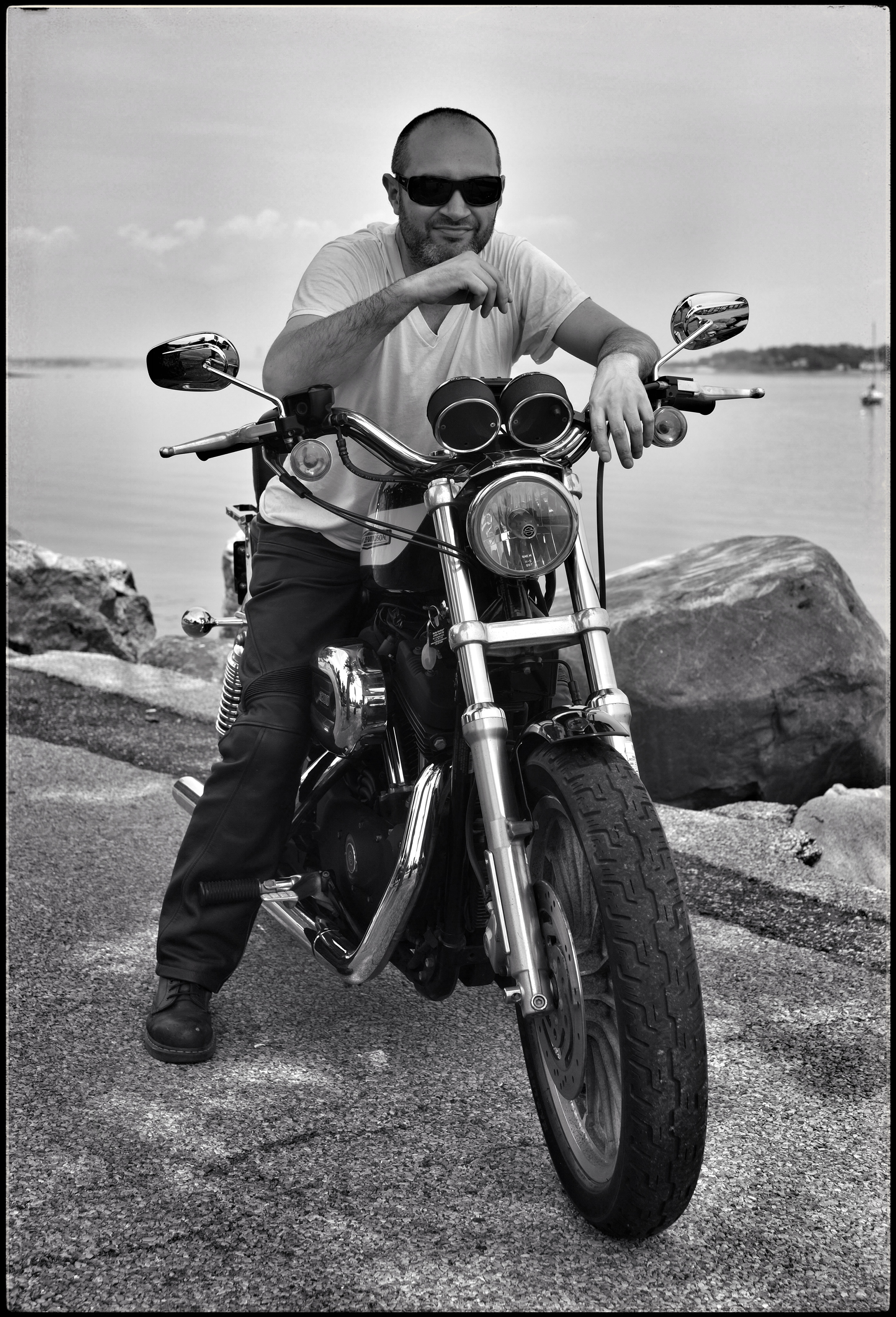
Jason took off his leather and underneath he sported a plain whte T with a v-neck. I thought of Marlon Brando in the Wild Ones and liked his casual pose over the handlebars. His HD Sportster Roadster is a new acquisition, and he loves it, the gesture in his left hand shows that. I asked Jason pose in this spot, due to the shade the tree to camera left affords. I like the texture from the cucoloris effect as well, not too strong, not too light. The rocks in the background mimic the bad-ass attitude of the Harley Davidson while the line of the path draws you across the image nicely. Horizon neatly placed in the top third with a hint of clouds.

All the images were shot jpeg with the b&w style applied, then imported into Snapseed with my ipad workflow used. Ride on readers, and keep a sharp on the background (and potholes for NYC riders!)

~David

All Men Must Shoot : Valor More-Shootist

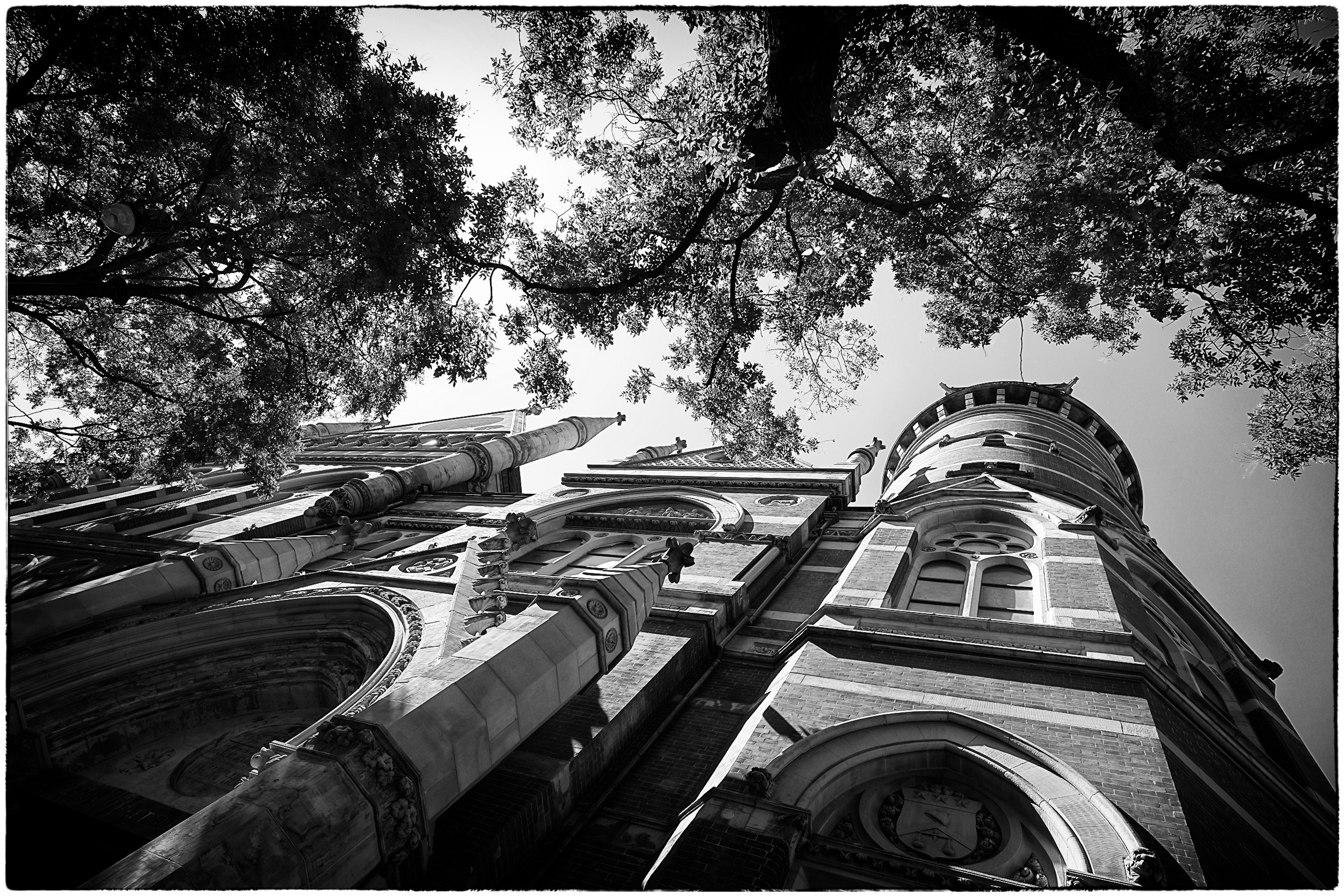
Looking Up into the Globe at Flushing Meadows Park

Looking Up into the Globe at Flushing Meadows Park


Yes, Game of Thrones inspires the title of this post. But worry not, I wont be blogging any spoilers. Actually this post has nothing to do with Game of Thrones at all, well except maybe a little regarding Winterfell, the northern kingdom that swears fealty to the Starks. In as much as Winterfell has long cold winters, they are similar to what we have gotten this year in NYC. This winter took me by a stranglehold, usually I deal with the cold pretty well, but this year I suffered creative frostbite. I was looking for a thaw, and some insight as well as further work on my style book, and I got none. Just the long winter nights.


it snowed and snowed for 22 instances this winter. 22!

it snowed and snowed for 22 instances this winter. 22!


Not that I didn’t try, I kept a camera always on the shoulder and walked with my eyes open, receiving, seeking. So as I sat back, edited and looked what the winter gave me, I was able to find a few images that I worked very hard for and I think bore some winter fruit.


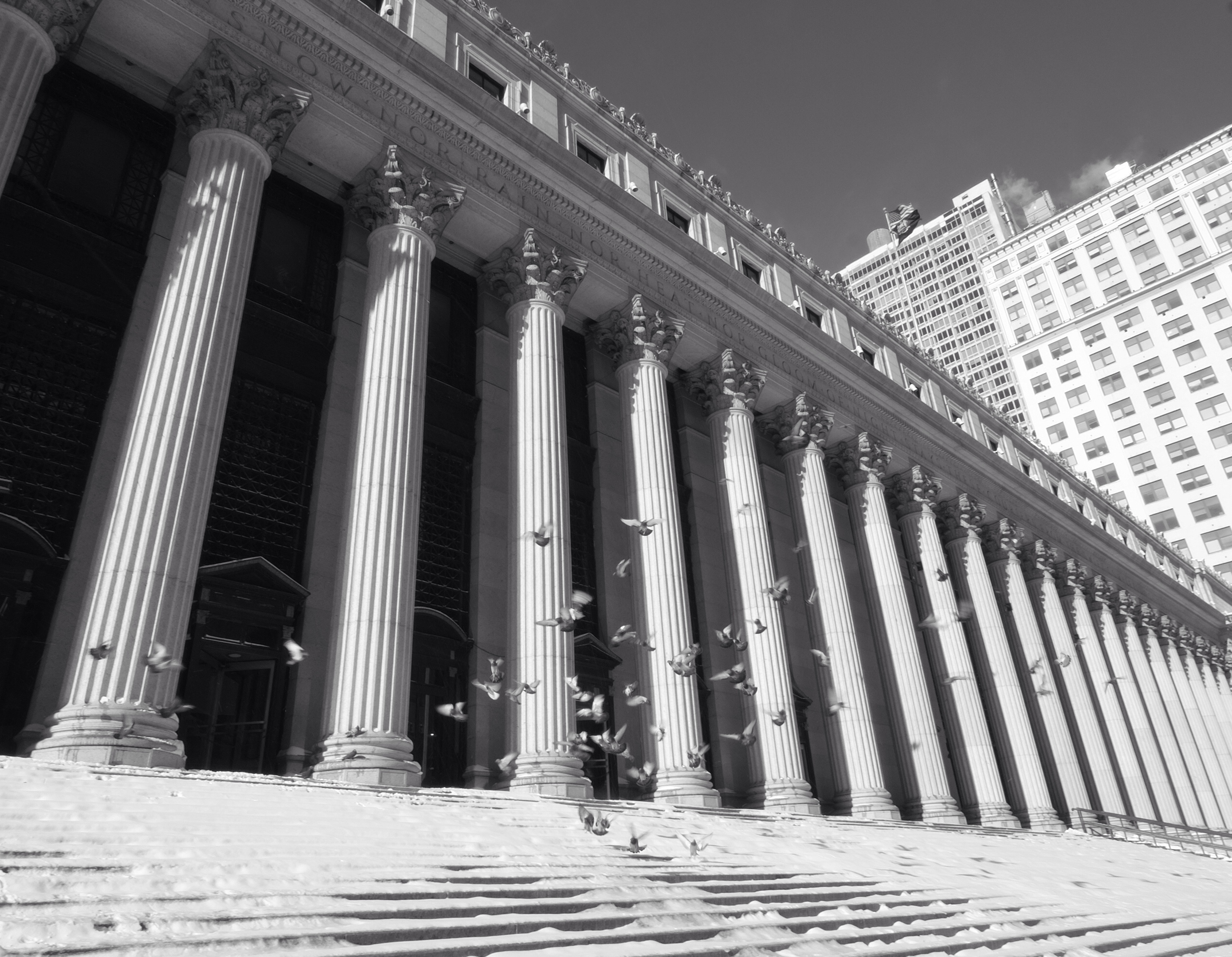
James McFarley Post Office, NYC.

James McFarley Post Office, NYC.


Pure Street Shooting for me, I could not resist shooting him.

Pure Street Shooting for me, I could not resist shooting him.


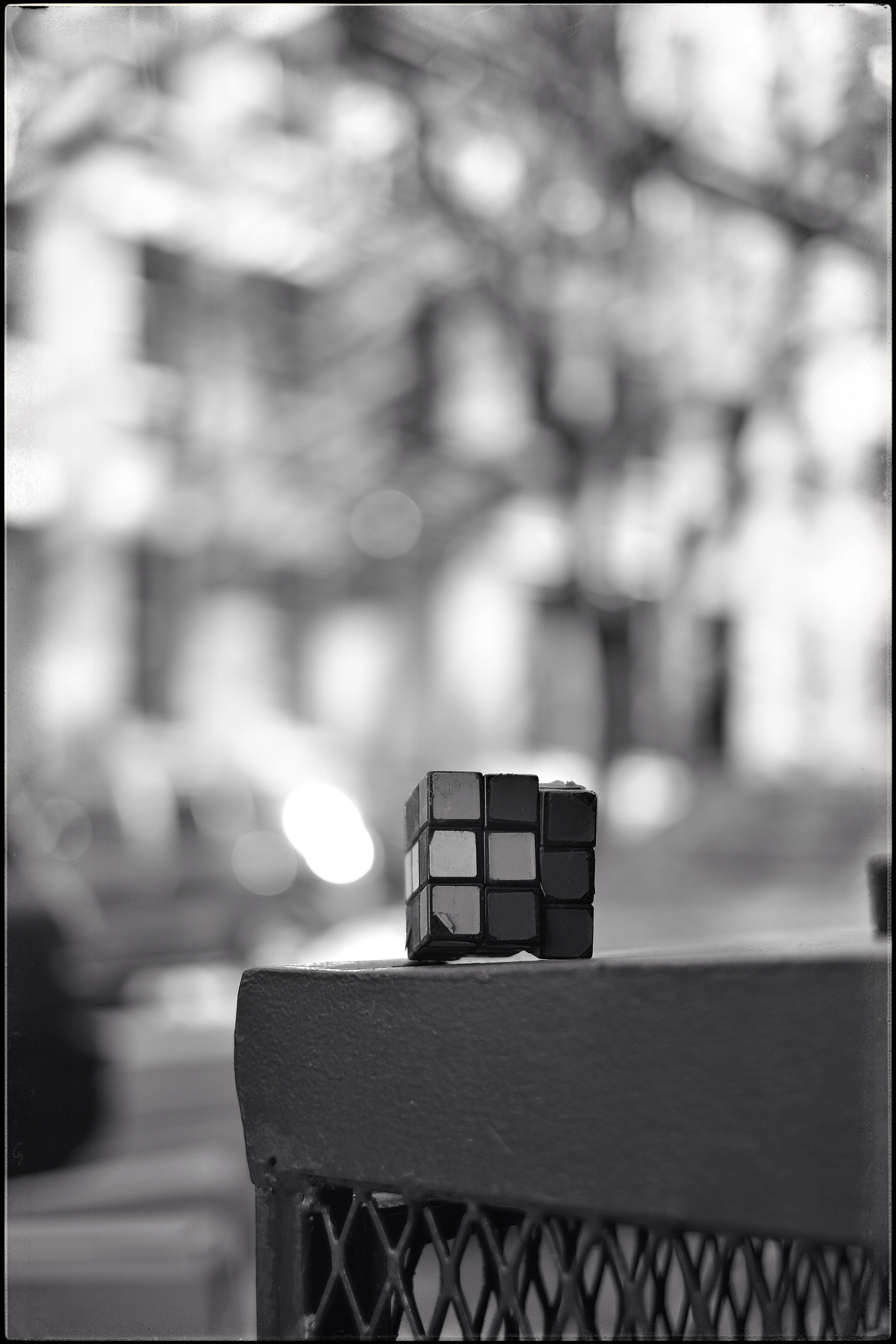
Puzzle with a healthy dose of Fujifilm 35 1.4 bokeh.

Puzzle with a healthy dose of Fujifilm 35 1.4 bokeh.


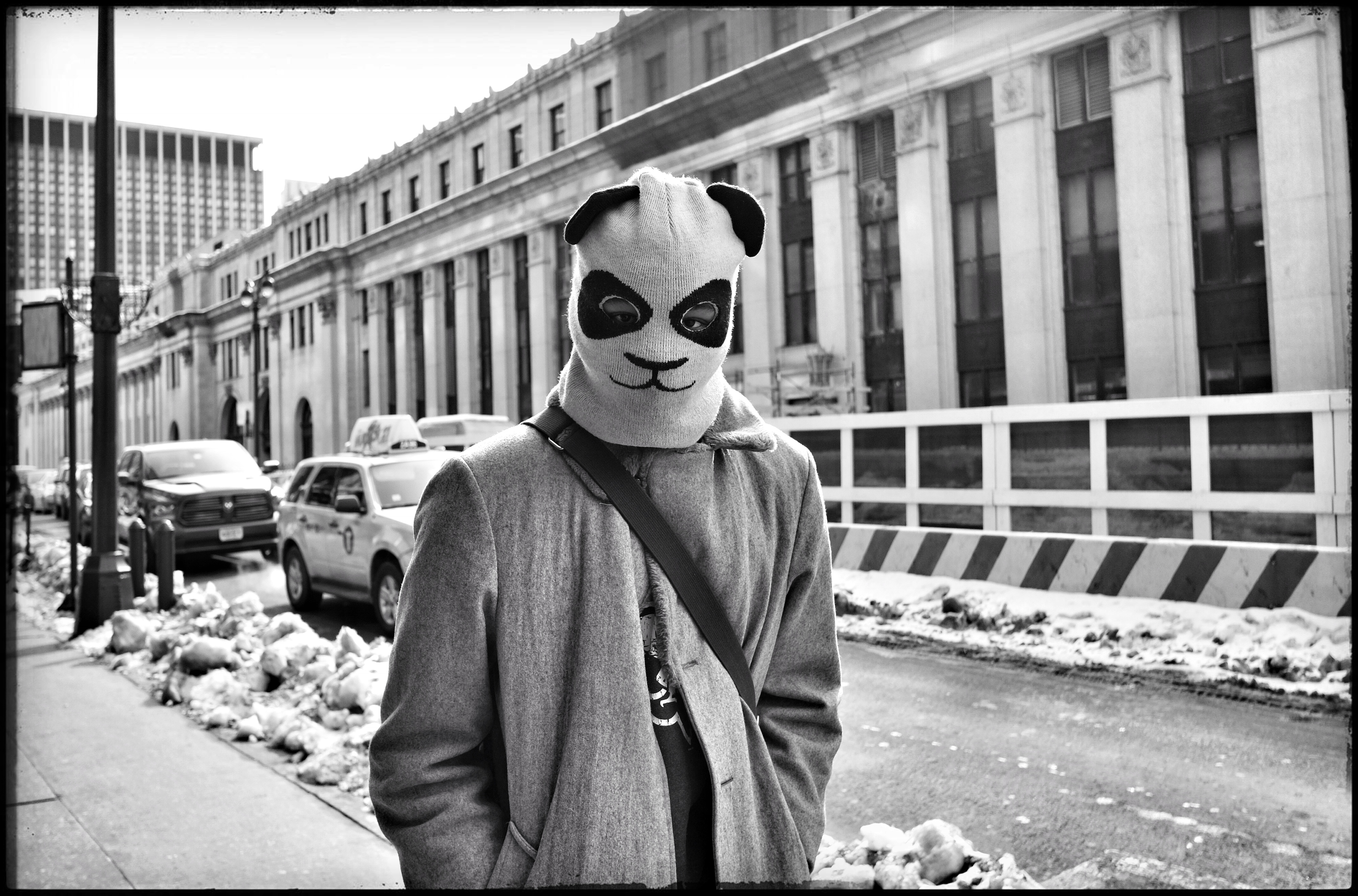
More street people.. this one staying warm with a cool panda ski mask.

More street people.. this one staying warm with a cool panda ski mask.

The lesson here is one I preach all the time, keep shooting. It can be hard and uninspiring often, but you must push on and find the shot.

In Game of Thrones there is a valerian saying, “Valor Morgulis” and it translates to “All Men Must Die”. It is the tag line for the 4th season; I dedicate these winter images to the modified sentiment, “All Men Must Photograph”.

~David

Climbing the Mountain – Thoughts on Finding Photographic Style

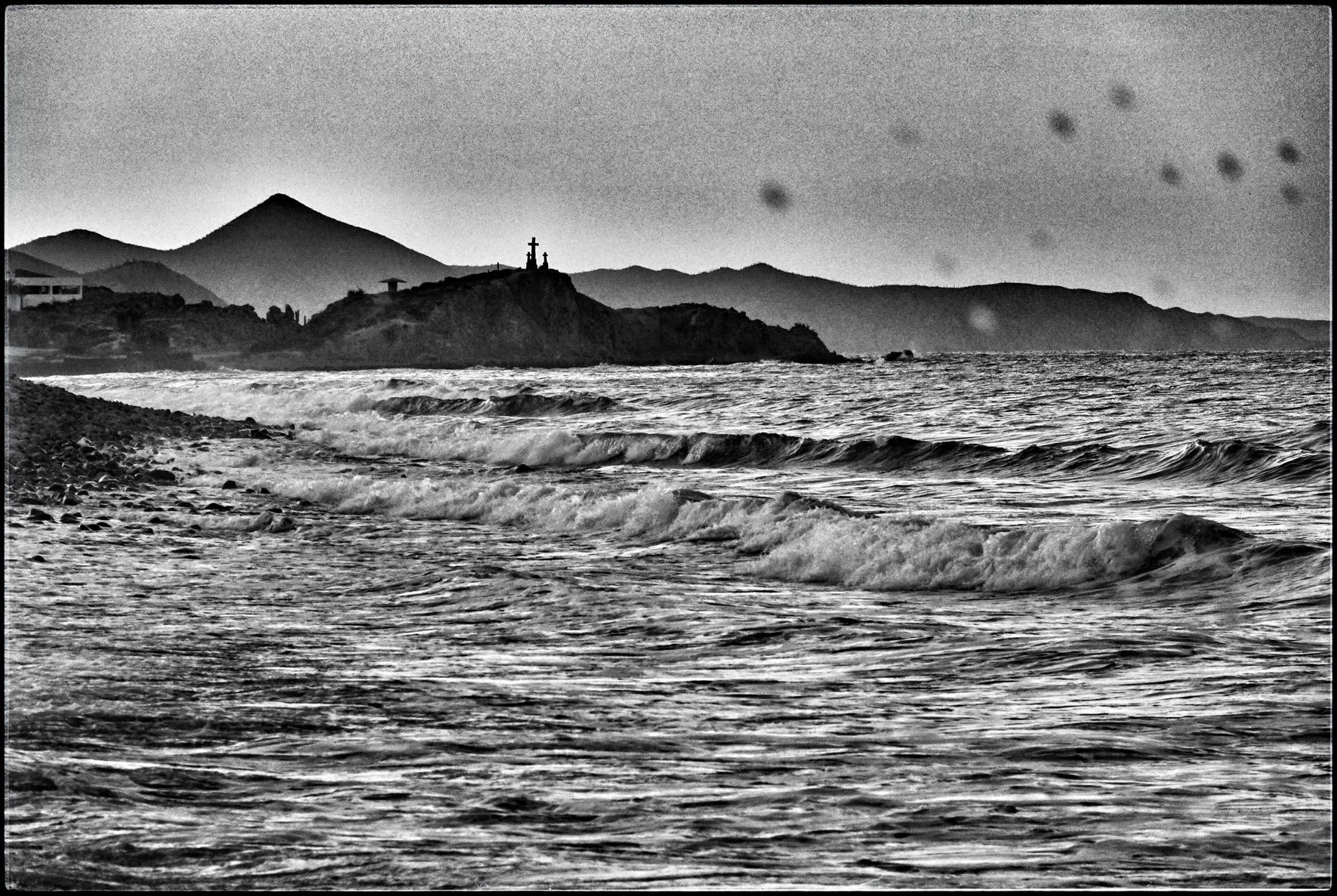
Rancho Los Cruces, Baja California Peninsula, Mexico. Sony RX10

Rancho Los Cruces, Baja California Peninsula, Mexico. Sony RX10

The Mountain. No, I’m not talking about a character form a George Martin novel or a Janes Addiction song. I’m talking about a vast project and desire to create something amazing. The Mountain is all the work ahead of you, all the plans, the complications, the raw effort. The Mountain soars in front of you, its height is dizzying and when you are in the shadow of the mountain the temptation to do nothing, to not try to move forward freezes you. Letting the mountain daunt you will be the equivalent of rolling over and going back to sleep, thus condemning you work to photographic mediocrity. But you are stronger; you will climb the mountain and figure out how to let your photographic voice soar in an orgy of style that will define your photography!

Adapting to the brutal winter of 2014 in NYC. Fujifilm Xpro1 18 mm f2.0

Adapting to the brutal winter of 2014 in NYC. Fujifilm Xpro1 18 mm f2.0

The way to go over the mountain of work ahead of you is actually quite easy. Take one step at a time and keep moving. I would now like to introduce you to something everyone one of us has in their pocket, The Goal Compass. Every great person who achieves something wonderful sets their goal compass and moves in that direction with little deviation. This doesn’t just apply to photographers, imagine Christopher Columbus and the mountain he had to climb to discover the new world. He needed ships, he needed sailors, he had to break a history of convention that stated what he wanted to do was impossible. The planning took over a decade, but he stayed the course and made his spot in history. He could not be deterred and every movement he made was aimed towards his goal. We are not explorers seeking the New World, we are photographers, and fortunately our goals are easier than Columbus.

However the Mountain does stand before us and it can be daunting. By setting the goal compass on plateaus to traverse you will be amazed at the creative ground you will cover. Here is style deconstructed and that which reveals a simple formula  serving as a map to travel over the mountain in the most expedient way.

  1. Master the camera and lens you are utilizing. Use a specific technique to create the image and perform specific post process treatments.

  2. Find subject manner you want to explore deeper. This is idea made reality in the camera viewfinder.

  3. Create a body of work around the subject and place by using the same camera and techniques.

The Euclidean triangle that is the base to developing photographic style. At what point on the triangle are you?

Note: This is an exert from my upcoming book on Finding and Developing Photographic Style. Want to learn more? Come to Brommer’s Style and Composition in NYC Workshop in April.

suspectworkshopbanner

Finding Photographic Style and Composition in NYC 4 Day Intensive Workshop April 17th to April 20th

Message Man in Chelsea

Finding Photographic Style and Composition in NYC  is a four day intensive workshop to develop your style and advance your composition skills with classroom sessions, assignments, museum and gallery visits, critiques, and guided photo walks in some of NYC’s iconic neighborhoods led by David Brommer. Photographers who are looking to perfect their skills and spend every waking moment in the city that never sleeps will be taking advantage of high level instruction and techniques with an emphasis on creating a body of work that will feature their own voice. Being exposed to new visual concepts and photographs from a series of visits to selected Chelsea galleries and two iconic photo collections at ICP and MoMA, students will ultimately build a solid portfolio of images.

chelsea

Classroom sessions: In this part of the program, David Brommer will deliver his two signature lectures “Finding Photographic Style” and “Composition Beyond the Rule of Thirds”  to give you the right tools to create a series of compelling images during your time in NYC. The classroom will serve as a home base, providing an environment for post processing and critique sessions, as well as working as an arena to discuss ideas and evaluate progress. The classroom sessions will be held at the photo department of New York Film Academy , a brand new facility in Battery Park  with state of the art classrooms with views of the Statue of Liberty and the port of NYC.

Photo Walks: The photo walks will explore iconic neighborhoods and landmarks including The Brooklyn Bridge, Lower Manhattan, Central Park, The West Village, Times Square and Grand Central Station. A live model will be available for one selected location photo shoot that will also feature a mini lighting workshop.

Gallery Visits: The neighborhood of Chelsea, with its more than 300 galleries, has the highest concentration of visual art per square foot on the entire planet. This experience will be a unique opportunity to visit key institutions and enjoy short gallery talks.  The itinerary will include Steven Kasher Gallery, Robert Mann Gallery, Bruce Silverstein Gallery and Clamp Art.

Final Party: The grand finale of the workshop will be the “Black & White” dinner, a party hosted by David Brommer and his wife Barbara. During the party the students will showcase their work and enjoy a “Black & White” menu of photography inspired gourmet dishes created by Barbara, (a chef and Bauhaus schooled artist).

Notes: This is an intensive workshop with lots of walking. It is not a basic class, it is intended for intermediate and advanced photographers. Class is strictly limited to 12 students. Be prepared to work hard, create dynamic photographs and grow as an artist.

Fee: The fee for the workshop is $699.00. Workshop is limited to a maximum of 12 students. The fee includes admission to ICP and MoMA and the final party.

Meals are not included, however we will be enjoying the vibrant NYC food scene.

Payments: A $200 dollar deposit is required to hold your reservation. The final balance is due March 31st. Students paying in full by March 1st receive a $50 discount for the workshop (for this option, please use the Early Bird Enrollment button to pay).

Chose your payment option from one of the three below:


Workshop Cancelled. Subscribe to this blog to find out when more will be offered.


The Workshop Reservation Deposit ($200.00) is NOT refundable. If you cancel before April 15th you will obtain the fee refund minus the deposit amount (i.e. Workshop cancellations are subject to a $200.00 fee).

If you wish to pay by check please email me directly for instructions and payment information.

Any students who wish to bring a Fujifilm X System camera will receive special love. However, any digital camera or iphone is recommended. While the Suspect does love film, it will be hard to add film to the critique sessions and receive instant feedback.

Any questions please feel free to email or ask in the comment field. Thank you and see you NYC soon.

libraryon6th

Keep Calm and Carry Cameras II

What the Garbage Truck Sees

This is a short and sweet post, it’s about something I have said in this recent post, “always carry a camera”. You just never know when the photography gods will throw you a good image to capture. On the street, or just coming out of your bathroom. Carry that camera.

So here’s the story, on Sunday mornings I head out to La Bergamote bakery to pick up some croissants to bring back for breakfast. This trip takes me down 9th ave, and sometimes, I head east to 8th ave if I’m in the mood for bagels and lox from Brooklyn Bagel Company. Mostly though, it’s all about the croissant. I always grab my camera, because La Bergamote is in the heart of Chelsea and the architecture and tree lined streets is just perfect in so many ways. It was early on this particular Sunday morning, and cloudless. On the Corner of 22nd and 9th Avenue a Garbage truck had pulled in the corner diagonally so that its front pointed across the street instead of down the street. While a normal site on the streets of NYC, as I crossed it I noticed the windows reflected the buildings across in an interesting composition. Standing almost in the middle of the street I took some time to compose the image, falling into that tantric composition photo seeing trance through the viewfinder that only ones who love photography can understand. Time stands still, traffic matters not and in a 250th of a second it’s done. Exposure made, for better or worse or most likely, for nothing really because only a small percentage of images actually has any guts to it- destined to fall deeply into a folder on the hard drive.

Later during breakfast I did a chimping session and thought, “you know what David, you got something here…” so I downloaded the image onto my iPad and started to do my new workflow with snapseed and was quite surprised at the final edited image. I posted it on my Facebook and got loads of Likes. I’m so happy I brought the Fujifilm Xpro1 with 18mm f2.0 on that croissant mission.

before and after


Fast forward a week later, and I visited the bathroom early this morning. Of course I had the requisite iPad with me, and I was sitting there, through the door I spied the rising sun pouring through the windows and shedding light on my wife Barbara’s cabinet. Click.

 Heads greeting the morning sun.

Photography is about so much, and sometimes I just blush with happiness, when all that matters is making the image. I friend of mine recently posted a shot of her under the darkcloth of a Deardorff on Facebook, as I was writing this post I had spotted it on my feed, We had a short exchange and Kendra gets it, she said, “love it”.

photodialog

Check out Kendra’s work, she shoots Tin Types and brings a wonderful aesthetic to her work. When I first met her she was shooting with a 4×5 Speed Graphic, now she’s rolling big time with a 8×10 Deardorff!  Look at those TinTypes, thats LOVE! www.kendraesadams.com

That’s all there is to this I guess. Carry a camera, keep calm, and love it.


~David